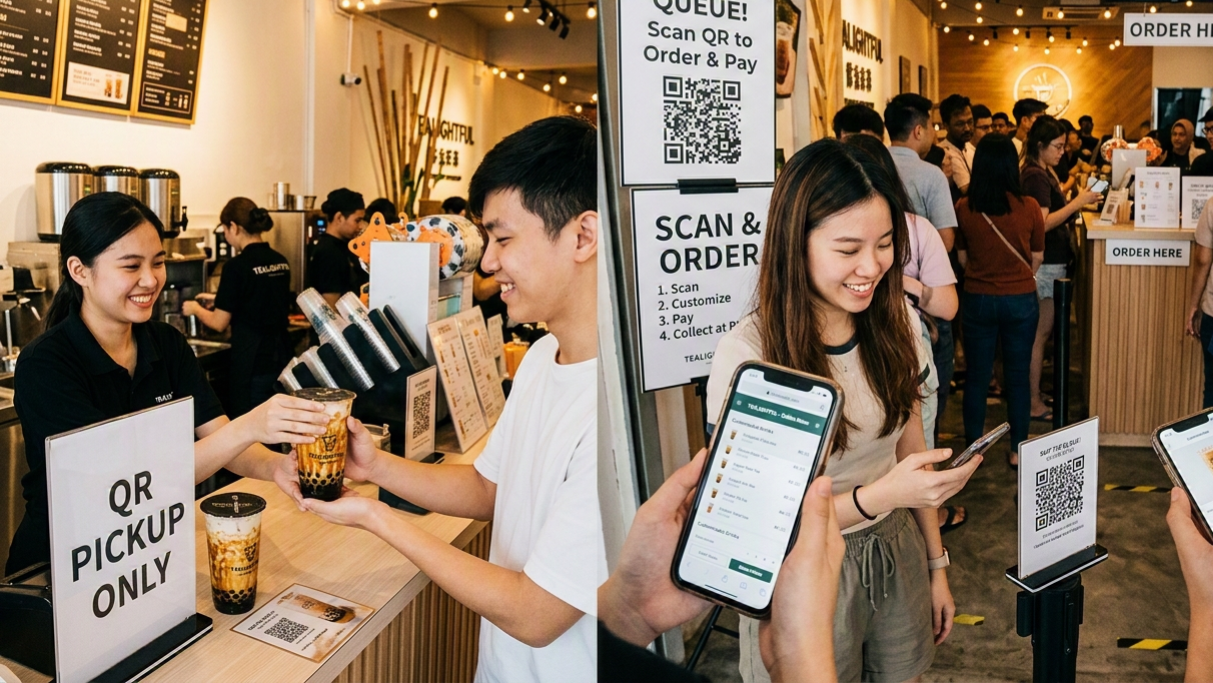
Bubble tea has one of the most punishing order-taking problems in food and beverage. It isn't the menu size — it's the combinations. Sugar level, ice level, toppings, milk or non-dairy base, extra pearls, size — a single cup can have dozens of valid permutations, and every one of them has to be captured correctly, by hand, while a queue is watching the clock.
In Malaysia, that pressure shows up in predictable spikes: after school, after work, weekend mall crowds, and the first hot afternoon after a week of rain. QR ordering doesn't remove those spikes, but it changes where the bottleneck sits — from "how fast can one cashier type an order" to "how fast can the counter make drinks," which is a much better problem to have.
Why Bubble Tea Queues Are Uniquely Painful
- High customization per order. Unlike a fixed-menu item, almost every cup is a custom build, and every extra question at the till adds seconds that multiply down the queue.
- Peak concentration. Demand doesn't spread evenly through the day — it clusters into short, intense windows, so a slow order-taking process gets punished hardest exactly when it matters most.
- Small counter footprint. Most bubble tea shops in Malaysia run lean — one or two staff on till and drinks — so any time spent repeating an order back to a customer is time not spent shaking and sealing cups.
- Handwriting errors. Cup labels scrawled under pressure are a common source of wrong sugar levels, missed toppings, and remakes — all of which slow the line down further.
What QR Ordering Looks Like for a Bubble Tea Counter
Instead of joining a single line to order and pay at the till, customers scan a QR code — placed at the queue entrance, on the counter, or on table tents if there's seating — and order straight from their phone. The customization that used to take a back-and-forth conversation becomes a few taps: pick the drink, set sugar and ice level, add toppings, choose size, pay.
The order goes straight to the counter or a kitchen display or ticket printer, exactly as specified, with no relay through a cashier required. Customers can then queue physically for pickup, or simply wait for a ready notification if the shop supports it.
The Customer Journey, Step by Step
- Customer sees the queue, scans the QR code posted near the entrance or counter.
- They browse the digital menu, which can show photos, best-sellers, and current promotions — something a printed menu board can't do.
- They customize sugar level, ice level, toppings, and size directly, without needing to shout it over the counter.
- They pay on the spot using local rails — DuitNow QR, Touch 'n Go eWallet, GrabPay, or card — no cash handling needed at the till.
- They get a queue number or order status, and collect their drink once it's called or notified as ready.
The physical queue for drinks doesn't disappear — but the ordering queue does, which is usually the slower of the two.
The Real Benefits for a Bubble Tea Shop
Faster line throughput
When ordering and payment happen on a customer's own phone, the counter isn't gated by one person taking orders one at a time. Multiple customers can order simultaneously while queuing, so more people move through the line per hour without adding staff.
Fewer wrong orders
A digital order removes the guesswork of handwritten labels and mishearing "50% sugar, less ice" over a noisy counter. What the customer selects is exactly what gets made — fewer remakes, less wasted stock, and fewer unhappy customers.
Staff freed up for drink-making
With fewer staff needed to take and repeat orders, more hands are free for shaking, sealing, and serving — the part of the job that actually determines how fast the queue moves.
Upsell without the awkward ask
A digital menu can surface add-ons — extra pearls, a size upgrade, a seasonal flavor — as simple taps, something a rushed cashier rarely has time to pitch during a queue crunch.
Data on what's actually selling
Every order captured digitally becomes data: which flavors move fastest, which sugar/ice combinations are most common, and when your real peak hours are — useful for staffing, stock ordering, and menu decisions.
Built for how Malaysians already pay
QR ordering paired with local e-wallets and DuitNow QR fits naturally into a market where scanning to pay is already second nature, so there's little behavior change required from customers.
Getting It Right at the Counter
- Put the QR code where the queue actually forms — at the entrance or early in the line — not just at the till, so people can order before they've even reached the counter.
- Keep the menu structure simple. Group by drink category first, then let customization happen in a clear, guided flow rather than one long list of options.
- Set sensible defaults. Pre-select the most common sugar and ice level so regular customers can order in seconds, while still letting anyone adjust it.
- Keep a manual fallback. A short queue of walk-ins who prefer ordering at the counter should still be handled smoothly — QR ordering should add a lane, not remove one.
- Make pickup obvious. A clear queue number or order-ready display avoids a new bottleneck forming at the collection point instead of the till.
Frequently Asked Questions
Do customers need to download an app?
No — QR ordering typically opens straight in the phone's browser, so there's nothing to install. That's a big part of why adoption tends to be fast.
Will older or less tech-savvy customers struggle with it?
Keep a counter option running alongside QR ordering. Most bubble tea customers are comfortable scanning to pay already, but a manual lane covers everyone else.
Does QR ordering work for takeaway-only shops without seating?
Yes — the QR code doesn't need to be on a table. Posting it at the queue entrance or counter works just as well for a pure takeaway format.
How does payment work with QR ordering in Malaysia?
Most systems support DuitNow QR and popular e-wallets like Touch 'n Go and GrabPay, so customers can pay the same way they already pay elsewhere.
The Bottom Line
Bubble tea queues aren't slow because staff are slow — they're slow because every cup is a custom order taken one conversation at a time. QR ordering moves that conversation onto the customer's own phone, so the counter's real bottleneck becomes making drinks, not writing down orders. For shops dealing with regular after-school and after-work rushes, that shift alone can be the difference between a queue that clears and one that costs you walk-away customers.
Ready to shorten your queue?
See how ROVA sets up QR ordering for bubble tea and F&B shops across Malaysia — menu, customization, and local payments included.
Talk to ROVA