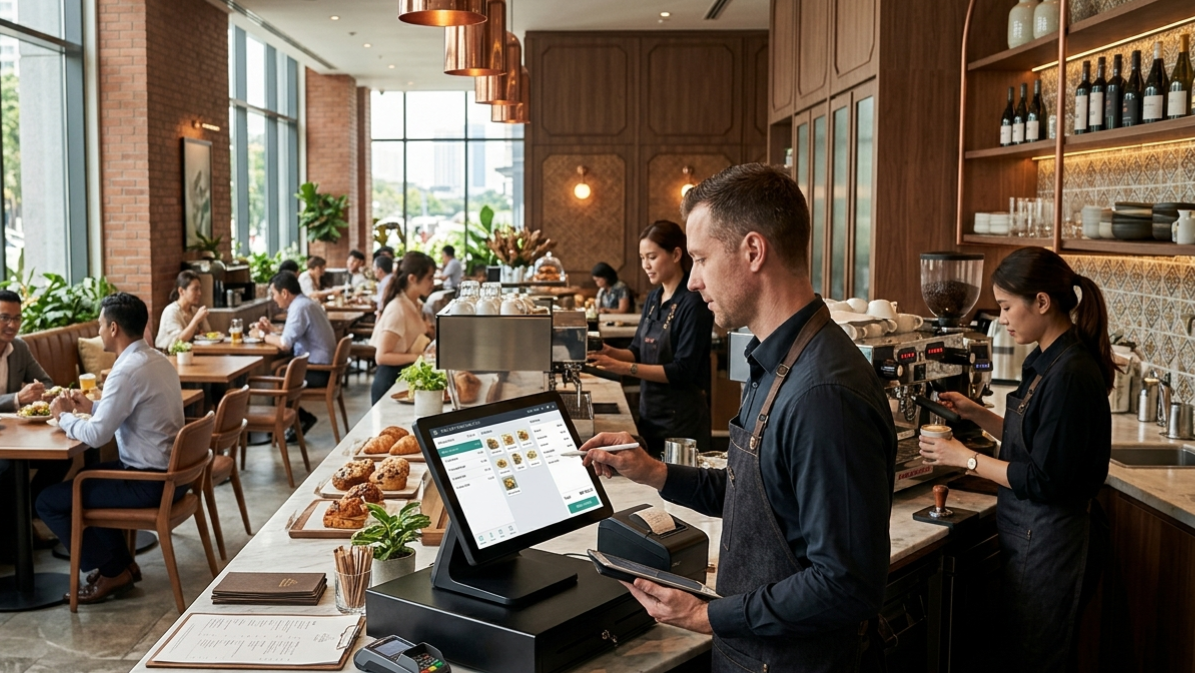
Johor Bahru is no longer just a weekend shopping destination for Singaporeans. It's rapidly becoming one of the most competitive restaurant markets in Malaysia — and one of the fastest to digitise. With the Johor-Singapore Special Economic Zone (JS-SEZ) drawing new investment, Iskandar Puteri expanding, and tourist arrivals climbing year on year, the pressure on JB restaurant operators to run lean and serve fast has never been greater.
If you're running a restaurant, café, kopitiam, or mamak in Johor Bahru right now, one question matters more than any other: is your operation built to handle the volume that's coming? A modern restaurant management system is how you get there — not by spending six figures on enterprise hardware, but by choosing an affordable, locally-supported platform that removes friction from every step between customer and kitchen.
This guide breaks down what a restaurant management system actually is, why JB operators specifically are adopting them right now, what to look for, and how to get started without overcomplicating it.
What is a restaurant management system?
A restaurant management system (RMS) is an integrated software platform that handles the key operational workflows of a food and beverage business from a single interface. At its core, it connects the moment a customer places an order to the moment the kitchen fires it — and everything in between.
A modern RMS built for Malaysian F&B typically includes:
QR Ordering
Customers scan a table code, browse your digital menu, and order from their own phone — no app, no sign-up, no waiting for a waiter.
POS Integration
All orders — dine-in, takeaway, delivery — flow into one unified point-of-sale system with unified sales reporting.
Kitchen Sync
Orders fire automatically to a kitchen display or printer. No relay, no miscomm, no missed tickets during the lunch rush.
Menu Management
Update prices, 86 sold-out items, and add new dishes in real time from your phone — no reprinting, no whiteboard updates.
Digital Payments
Accept Touch 'n Go eWallet, GrabPay, DuitNow QR, card, and cash from a single system — with automatic reconciliation.
Sales Reporting
See your top-selling items, peak hours, daily revenue, and table turnover — from any device, any time.
The term "restaurant management system" is sometimes used interchangeably with POS system, but modern RMS platforms go further — they connect front-of-house, kitchen, and back-office into one data loop, rather than just processing payments at a counter.
Why Johor Bahru restaurants need one right now
The JB F&B landscape in 2026 is being shaped by three forces that are converging simultaneously — and each one creates a different kind of pressure on operators.
1. The tourist surge is real, and it's accelerating
Johor attracted over 9.2 million international visitors in 2024, with Singaporeans making up the majority of that figure. Average spending per Singaporean arrival grew to RM 850 in 2024 — a 15% jump year-on-year. With the JS-SEZ formalising cross-border economic integration and Visit Johor Year 2026 on the horizon, the footfall trend is heading in one direction. Restaurants that can't handle surge volume — both in service speed and payment convenience — are leaving money at the table.
The Singaporean diner expects digital. Singapore's own F&B sector has been QR-ordering and contactless-paying for years. Visitors crossing the Causeway for a meal bring those expectations with them. A paper menu and a single card terminal is a friction point that costs you repeat visits.
2. New competition is landing — fast
Singaporean restaurant operators, squeezed by record rents and a labour shortage at home, are actively expanding into JB. Lower operating costs and favourable exchange rates make the city an attractive escape hatch. This isn't a trickle — it's a structural shift. Local JB operators who have been running on manual processes for years are suddenly competing with digitally-savvy outlets that have perfected their systems across the Causeway.
3. Labour costs are rising, headcount is harder to find
Malaysia's minimum wage increase in 2026 hit JB operators alongside the rest of the country — but in a city where proximity to Singapore makes cross-border commuting attractive for skilled workers, the talent retention challenge is particularly acute. A restaurant management system doesn't replace your team; it lets a smaller team handle higher volume without burning out. When orders flow from phone to kitchen automatically, your front-of-house staff can focus on hospitality rather than order-taking mechanics.
What makes a restaurant management system "affordable"?
The word affordable gets used loosely in software sales, so here's what it should actually mean for a JB F&B operator:
- No proprietary hardware required. A system that demands you buy a RM 3,000+ hardware bundle before you've done a single transaction is not affordable. The best modern platforms work with your existing receipt printer and run the merchant dashboard on any browser.
- Transparent monthly pricing. Watch for hidden transaction fees, per-outlet charges, and premium tier lock-ins on features you actually need. The real monthly cost of some "entry-level" plans is 2–3x the headline price once you factor in transaction fees on all orders.
- Fast setup, no lengthy onboarding. Time-to-value matters. If it takes two weeks of consultant visits to go live, the system isn't built for small operators. The right RMS should have your outlet running within a day.
- Local support. A platform with no Malaysian support contact means you're calling a hotline in another timezone when your system goes down on a Friday dinner rush.
- No app download for customers. Any system that requires diners to install an app before they can order has already lost you a significant portion of tables. Browser-based ordering is the standard in 2026.
The real cost of not having a system
Many JB operators delay adopting an RMS because they don't see the immediate cost of running without one. But manual operations carry a hidden price that compounds monthly:
A 40-seat café running manual order-taking typically handles 2–3 table turns during a two-hour lunch rush. The same café with QR ordering and kitchen sync routinely adds one additional turn — because customers order faster, the kitchen starts earlier, and bills settle without waiting for staff to run the check. At RM 35 average spend per person, one extra table turn across 8 tables is RM 280 in additional revenue per lunch service. Over 25 operating days, that's RM 7,000 per month the manual operation leaves behind.
Beyond revenue, kitchen errors that come from order miscommunication result in comped meals, wasted ingredients, and unhappy diners who don't come back. In a city where word-of-mouth from Singaporean visitors travels fast across social media, one bad experience has outsized consequences.
Key features to look for in a JB context
Johor Bahru has some specific requirements that not every platform handles well. When evaluating a restaurant management system for a JB outlet, prioritise these:
- Multilingual menu support. Your diners may prefer to browse in English, Bahasa Malaysia, or Chinese. A system that only supports one language limits your accessibility — particularly with the volume of Malaysian Chinese diners and Singaporean visitors in JB.
- DuitNow QR and local e-wallet integration. Touch 'n Go eWallet, GrabPay, and DuitNow QR are how most Malaysian diners pay in 2026. A system without these built in creates unnecessary friction.
- Mobile-first customer experience. JB diners are on Android and iOS. Your ordering interface needs to be fast, responsive, and functional on mid-range devices — not just the latest flagship.
- Real-time menu updates. Running out of nasi lemak at 10am? Sold out of the hari raya special? You need to update availability instantly from your phone, not log into a desktop dashboard and wait for changes to propagate.
- Simple enough for your floor team. Your serving staff may turn over. A system with a steep learning curve creates ongoing training overhead. Clean, intuitive UI is not a luxury — it's an operational necessity.
How ROVA fits the Johor Bahru market
ROVA is a Malaysian-built restaurant management platform designed specifically for local F&B operators. It's not an adapted global product retrofitted for Malaysia — it was built from scratch for the Malaysian context, which means DuitNow and local e-wallets are supported natively, the customer menu loads fast on Malaysian mobile networks, and the support team operates locally.
For a JB restaurant owner, the practical picture looks like this: you print QR stickers for each table, connect your existing kitchen printer or display, configure your menu through a browser dashboard, and you're taking QR orders — typically within the same day you sign up. There's no hardware to purchase, no multi-week onboarding process, and no transaction fees eating into already-tight margins.
As your operation grows — whether that's adding a second outlet in Iskandar Puteri or expanding to dine-in plus takeaway — the platform grows with you. Upcoming features include e-invoicing (important as Malaysia's e-invoice mandate rolls out), table reservations, and food pickup ordering.
Getting started: a practical step-by-step
If you've been putting off adopting a restaurant management system because it seems complicated or expensive, here's what the actual process looks like with a modern platform:
- Sign up and set up your menu Add your menu items, categories, photos, and prices through the web dashboard. Most operators with an existing digital menu can complete this in under two hours.
- Configure your tables Assign a QR code to each table in your floor plan. The QR stickers are printed — no expensive hardware terminals per table.
- Connect your kitchen output Link your existing receipt printer or kitchen display. Orders placed via QR fire directly to the kitchen the moment a customer confirms.
- Enable payments Connect your preferred Malaysian payment gateway to accept DuitNow, e-wallets, and cards. All transactions reconcile automatically in your dashboard.
- Go live Place QR stickers on tables, brief your team on the dashboard, and start taking orders. Most JB operators are fully live within one business day.
The bottom line for JB operators
Johor Bahru's restaurant market is entering a period of sustained growth — but that growth will be uneven. Operators who can serve faster, reduce errors, handle contactless payments, and adapt their menus in real time will capture a disproportionate share of the tourist and local dine-in spend that's flowing into the city.
A restaurant management system for Johor Bahru isn't an IT project. It's the operational foundation that makes the difference between a table that turns three times during lunch and a table that turns twice. Between a tourist who comes back and one who doesn't. Between a kitchen that fires orders in two minutes and one that fires them in four.
The barrier to entry has never been lower. The right platform is affordable, fast to deploy, and built for the way Malaysian restaurants actually operate. The only cost is in waiting.
Ready to modernise your JB restaurant?
ROVA is built for Malaysian F&B — QR ordering, kitchen sync, digital payments, and real-time menu management in one affordable platform. Go live today.
Get Started Free