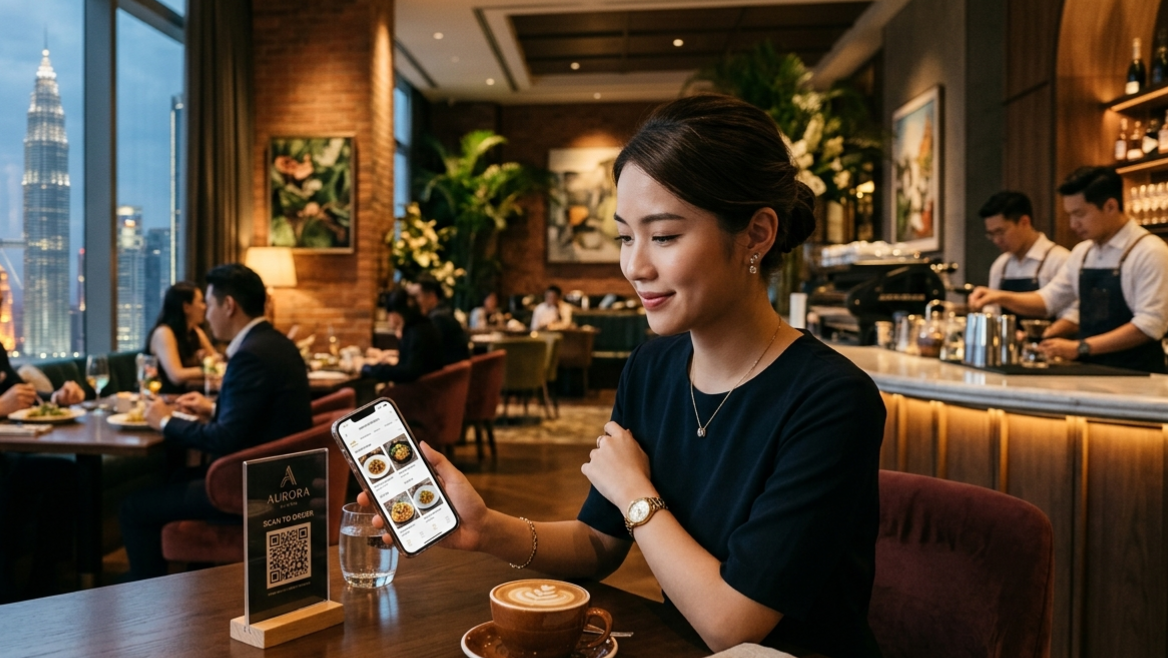
What Does "QR POS" Actually Mean?
If you've been Googling POS QR means or trying to figure out the difference between a plain QR code and a QR code POS system, you're not alone. Let's clear it up fast.
A traditional POS (Point-of-Sale) system is the software and hardware that processes orders and payments in a restaurant. A QR POS — or POS system with QR code — layers a scannable QR code on top of that, so customers can browse the menu, place orders, and even pay directly from their smartphone. No physical menu, no waiting for a server to take your order.
"QR POS" simply means a Point-of-Sale system where customers interact through a QR code — removing the bottleneck between the customer wanting something and the kitchen knowing about it.
In Kuala Lumpur, where dining culture ranges from packed mamak stalls at 2 AM to high-end KLCC restaurants, this kind of system has gone from novelty to necessity post-pandemic.
Why KL Restaurants Are Adopting QR Ordering Fast
Kuala Lumpur's F&B scene faces a perfect storm of pressures: rising labour costs, intense competition, and a customer base that is already among the most digitally fluent in ASEAN. A QR ordering system in Kuala Lumpur directly addresses all three.
Labour Shortage
One server can manage 3× more tables when orders come in via QR — no manual order-taking required.
Higher Spend Per Table
Digital menus surface add-ons, upsells, and promotions that are easy to miss on a printed card.
Mobile-First Diners
Malaysians are extremely comfortable scanning QR codes — they use them daily for DuitNow, Touch 'n Go, and more.
Peak-Hour Throughput
During the lunchtime rush in Bukit Bintang or Bangsar, faster ordering means more covers and more revenue.
Real-Time Menu Updates
Sold out of Nasi Lemak? Update the menu in seconds — no reprints, no awkward "sorry, we don't have that" moments.
Hygiene & Trust
No physical menus means no shared surfaces — a genuine consideration that KL diners still appreciate post-pandemic.
How a QR Code POS System Works — Step by Step
Understanding the flow helps you see why a QR code POS system is more than just a digital menu. It's an end-to-end ordering infrastructure.
QR POS vs. Traditional POS: At a Glance
Still weighing up whether a POS system with QR code is worth the switch? Here's a direct comparison for a typical KL restaurant.
| Feature | Traditional POS | QR Code POS System |
|---|---|---|
| Order placement | Server takes order manually | Customer orders via phone |
| Menu updates | Reprint required (cost + time) | Instant, free, real-time |
| Order errors | Common (handwriting, noise) | Near-zero (digital input) |
| Staff required per shift | Higher headcount | Leaner team possible |
| Upsell capability | Server dependent | Built into menu UX |
| Peak-hour scalability | Bottlenecks at busy tables | Customers order at their pace |
| Multilingual menus | Expensive to print | Toggle BM / EN / CN easily |
| Data & analytics | Basic sales reports | Item popularity, peak times, etc. |
What to Look For in a QR Ordering System for KL Restaurants
Not every QR ordering system in Kuala Lumpur is built equal. When evaluating options, prioritise these seven criteria:
- Bilingual / multilingual menu support — KL diners speak BM, English, Mandarin, and Tamil. Your menu should too.
- Works without app download — the moment you require an app install, you lose a chunk of your customers. Browser-based is essential.
- Real-time kitchen integration — the order must hit the kitchen display or printer the instant it's placed, not after a sync delay.
- Local payment gateway support — DuitNow QR, Touch 'n Go eWallet, Boost, and major card schemes should all be supported.
- Reliable local support — you can't afford a system that goes down on a Friday night with no one to call. Choose a vendor with a KL-based support team.
- Easy menu management — your staff, not a developer, should be able to update prices and mark items sold-out in under 60 seconds.
- Analytics dashboard — know your bestsellers, peak ordering windows, and average spend per cover without needing a spreadsheet.
How ROVA's QR Ordering System Serves KL Restaurants
ROVA is built specifically for the Malaysian market, which means it understands the nuances that generic international platforms miss — from Ringgit formatting to Bahasa Malaysia menu support to integration with local e-wallets.
No-App QR Menu
Customers scan and order instantly in their phone browser — zero friction, zero downloads.
Live Menu Control
Update prices, toggle sold-out items, and run promotions from any device, anytime.
Malaysian Payments
DuitNow QR, Touch 'n Go, Boost, Visa/Mastercard — all in one checkout flow.
Smart Analytics
Real-time dashboards showing your top items, busiest hours, and per-table revenue.
KL-Based Support
Our support team understands Malaysian F&B operations. Help is a WhatsApp away.
Easy Onboarding
Most restaurants are live within one business day — no lengthy installation or training required.
Which Types of KL Restaurants Benefit Most?
A QR ordering system fits a wide range of F&B formats across Kuala Lumpur:
- Casual dining restaurants in Bangsar, Damansara, and Cheras — reduce wait times and free up servers for hospitality rather than order-taking.
- Hawker stalls and food courts — accept QR orders without hiring additional counter staff, especially useful in high-footfall areas like Petaling Street.
- Café chains in Publika, Sunway, and Mid Valley — manage complex customisations (oat milk, no sugar, extra shot) precisely through a digital order form.
- Hotel F&B outlets along KLCC and Bukit Bintang — support international guests with multilingual menus and seamless card payment.
- Cloud kitchens — use QR-based dine-in ordering for any physical pickup point without the cost of a full front-of-house team.
Frequently Asked Questions
Ready to Launch QR Ordering in Your KL Restaurant?
Join the growing number of Kuala Lumpur restaurants using ROVA to serve more guests, reduce errors, and grow revenue — all with a system built for Malaysia.