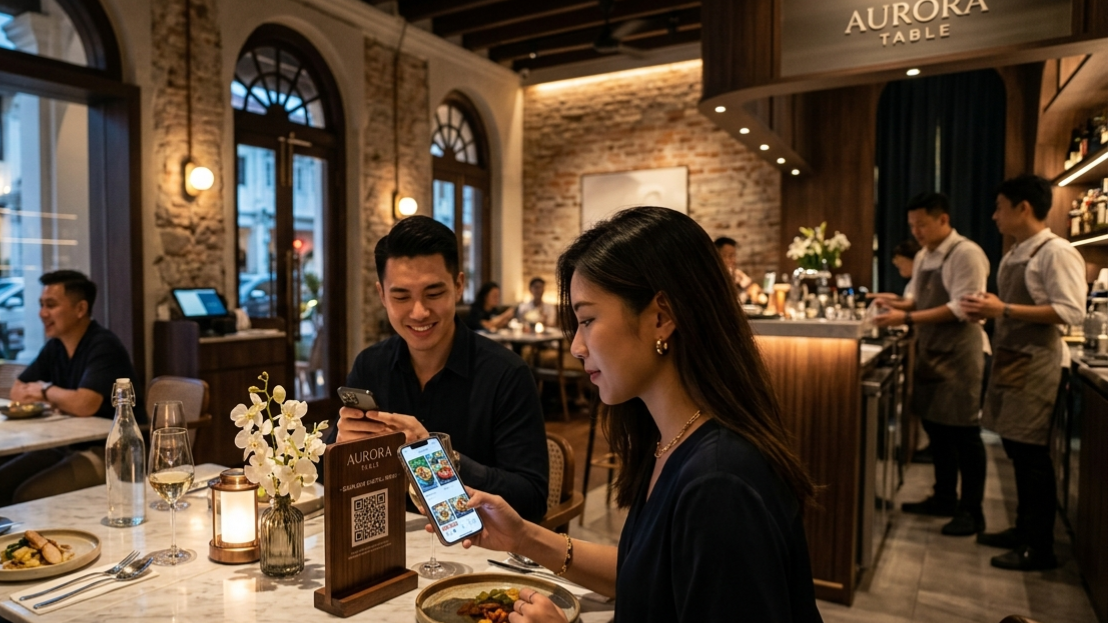
Penang has always had a complicated relationship with tradition. The same island that proudly guards century-old hawker recipes has also produced some of Malaysia's most tech-forward businesses. And right now, that tension is playing out at the dinner table — quite literally.
Walk into almost any coffee shop, casual eatery, or café along Gurney Drive, Georgetown, or Batu Ferringhi today and you're likely to find a small square printed on the table. Scan it, and your entire menu is on your phone. No laminated card, no waiting for a server, no "sorry, we ran out of that." Just a clean, scrollable digital menu — right there.
This is the QR menu shift happening across Penang's F&B scene. And for restaurant owners who haven't made the move yet, understanding what a QR menu restaurant in Penang actually gains — beyond just looking modern — is worth a closer look.
Why Penang Restaurants in Particular Are Embracing This
Penang's dining scene has a few characteristics that make QR menus especially useful compared to other parts of Malaysia.
First, tourism volume is high. Georgetown is a UNESCO World Heritage Site. Visitors from South Korea, China, Europe, and the wider region come specifically to eat here. A digital menu can display photos, descriptions, and even allergen information in a way that a printed Bahasa Malaysia or Chinese-only menu simply cannot. The gap between what a tourist wants to order and what they can confidently communicate closes significantly with a well-built QR menu.
Second, Penang's F&B market is competitive. There are more good options per square kilometre here than almost anywhere else in Malaysia. Standing out on Google Maps — which now factors in whether your menu is accessible and up to date — matters for discovery. Restaurants with accurate, navigable digital menus tend to rank better in local search and attract more "near me" traffic.
Third, labour costs and staff shortages are real. Running a busy kopitiam or café without enough front-of-house staff is a daily challenge. A QR menu doesn't replace your team — but it does reduce the time spent on menu recitation, order clarification, and repeat trips to the table.
83%
of diners prefer browsing a menu on their own device
2×
faster table turnover reported by QR-equipped restaurants
RM 0
cost to update a digital menu vs reprinting physical copies
The Hidden Costs of Sticking With Paper Menus
Paper menus feel free because the cost is spread out and invisible. But add it up and the picture changes.
- Reprinting costs — every price change, seasonal item, or sold-out dish either means a new print run or unsightly corrections taped over the old menu. A mid-range laminated menu redesign in Penang can run RM 200–800 depending on size and quantity.
- Hygiene concerns — physical menus are among the most touched surfaces in a restaurant. Post-pandemic, many customers are still quietly uncomfortable with them, even if they don't say so.
- Translation friction — if a meaningful portion of your customers are tourists or non-Malay speakers, a menu without photos or English descriptions is a barrier to upselling. Many diners simply order what they recognise rather than explore.
- No data — a paper menu tells you nothing. A digital menu, when paired with an ordering system, tells you which items get viewed most, which get abandoned at checkout, and what your peak ordering windows are.
- No shareability — a tourist can't send your menu link to their hotel group chat. Your paper menu doesn't appear in Google search results. It doesn't get saved to someone's phone before they visit.
The SEO angle most restaurants miss
A QR menu hosted on your own domain — with proper item names, descriptions, and photos — is indexable content. Every dish name is a potential long-tail search query. "Char kuey teow Georgetown", "nasi kandar Penang delivery" — these are real searches that a digital menu, properly set up, can help you rank for over time.
What a Good QR Menu System Actually Includes
Not all QR menus are created equal. A static PDF uploaded to a WhatsApp link is technically a digital menu — but it offers none of the operational or marketing benefits that make the switch worthwhile. Here's what a properly built QR menu restaurant system in Penang should include:
Mobile-optimised display
The menu should load fast and look great on any smartphone — including older Android models common among local diners. Photos should be compressed but clear. Categories should be scrollable without lag.
Real-time availability control
When you run out of something, you need to mark it unavailable in seconds — not wait for someone to print a "sold out" sticker. A good system lets you toggle items from your phone, instantly.
Photo support for every item
Photos drive orders. Menus with item photography consistently outperform text-only menus in average order value. This is especially powerful for tourists who can point at a picture even if they can't pronounce the dish.
Ordering capability (not just browsing)
A QR menu that only shows the menu is a PDF with extra steps. The real value comes when customers can add items to a cart, select options, and place an order — reducing your staff's workload and speeding up service.
Your own branding, your own link
The QR code should point to a page that looks like it belongs to your restaurant — not a generic platform. Your name, your logo, your colours. This is what builds recognition and makes the experience feel premium, not pieced together.
How ROVA Powers QR Menus for Penang Restaurants
ROVA is a Malaysian-built food ordering platform designed for exactly this use case — F&B businesses that want a clean, branded, fully functional digital menu and ordering experience without building one from scratch.
When you set up with ROVA, you get a branded ordering page with your own QR code, a menu you can manage from your phone, and an ordering flow that works for both dine-in and takeaway. Everything is hosted and maintained by ROVA — you don't need a developer, a web host, or any technical knowledge to run it.
Branded QR code
Printable, table-ready code that points directly to your menu
Phone-managed menu
Update items, prices, and photos from anywhere, instantly
Dine-in ordering
Customers order from the table — no staff needed to take every order
Takeaway & delivery link
Share your ordering link on WhatsApp, Instagram, or Google
Your brand, front and centre
Logo, colours, and name — no third-party branding cluttering the experience
Local support
ROVA is Malaysian — support that understands your context and language
The Marketing Upside Most Owners Underestimate
The operational benefits of a QR menu are obvious once you're using one. What takes longer to appreciate is what a well-run digital menu does for your visibility and marketing.
Google Business integration
When your menu is accessible via a link — not just a PDF — you can add it directly to your Google Business Profile. Customers searching "char kuey teow Penang" or "halal restaurant Georgetown" can see your menu items before they even click through to your page. This is a free, high-intent touchpoint that most Penang restaurants are leaving unused.
WhatsApp shareability
Penang has a strong group-chat food culture. When one person in a tourist group finds a great restaurant, they share the link. A ROVA ordering link is a shareable URL — meaning your menu can travel through WhatsApp groups, Telegram chats, and Instagram stories without you doing anything. A paper menu can't do that.
Upselling without the awkwardness
A digital menu can surface recommended add-ons, popular combos, or "customers also ordered" prompts — naturally, without a server feeling pressured to pitch. Many restaurants report a meaningful increase in average order value within the first month of switching, simply because customers discover items they wouldn't have thought to ask about.
Real-world scenario
A café in Georgetown adds a "Popular with this" suggestion under their nasi lemak — pointing to a teh tarik upgrade. No staff needed, no awkward upsell. Over a month of 400 daily orders, even a 10% uptake on a RM 3 add-on is RM 3,600 in additional revenue. The digital menu made that possible.
Addressing the Common Concerns
"My older customers won't use it."
This is the most common hesitation, and it deserves a direct answer. You don't need to remove your paper menus entirely — especially not at first. Run both in parallel. What most restaurant owners discover within a few weeks is that older customers adapt faster than expected, particularly when a family member helps once. And for every older customer who prefers paper, there are three younger ones who prefer digital and appreciate that you offer it.
"I'm not tech-savvy enough."
ROVA is designed for restaurant owners, not developers. If you can update a WhatsApp status, you can manage a ROVA menu. The setup is handled by the ROVA team — you hand over your menu, your photos, and your branding, and they build it for you. Ongoing management is done through a dashboard built for simplicity, not for engineers.
"My internet is unreliable."
ROVA menus load fast even on weaker mobile connections. Most customers viewing your menu are using their own mobile data — not your restaurant's WiFi. The pages are optimised for low-bandwidth environments because ROVA is built for the Malaysian market, where connection quality varies.
The competitive signal
In a market as food-dense as Penang, the restaurants that show up well on Google, load fast on mobile, and make it easy to order are increasingly the ones that win the evening booking and the tourist's first stop. A QR menu is no longer a differentiator — it's becoming the baseline expectation.
Getting Your Penang Restaurant Live With a QR Menu
The process with ROVA is straightforward. You don't need to set aside a weekend for it.
- Get in touch with ROVA — share your restaurant details and the ROVA team will walk you through the setup process.
- Send over your menu — a photo of your current menu, a spreadsheet, or even a voice note with your items and prices is enough to get started.
- Add your branding — your logo, a cover photo of your restaurant or food, and any colours you want reflected. ROVA handles the rest.
- Receive your QR code — print it on table cards, laminate it to your counter, add it to your packaging, or share the link on your social profiles.
- Go live — your digital menu is active and orders can start coming in.
Most Penang restaurants are fully set up within a few days of first contact.
The Bottom Line for Penang Restaurants
Penang's food culture is one of the strongest in Southeast Asia. It doesn't need to be "disrupted" — it needs to be equipped for how people discover, navigate, and share dining experiences in 2026. A QR menu is one of the most practical, affordable, and immediately impactful ways to do that.
Whether you're running a heritage kopitiam in Georgetown, a modern café near Straits Quay, or a family restaurant in Butterworth, the shift to a digital menu with real ordering capability is no longer a tech upgrade. It's a business one.
If you're ready to see what a QR menu could look like for your Penang restaurant, reach out to ROVA and get a demo built around your actual menu.