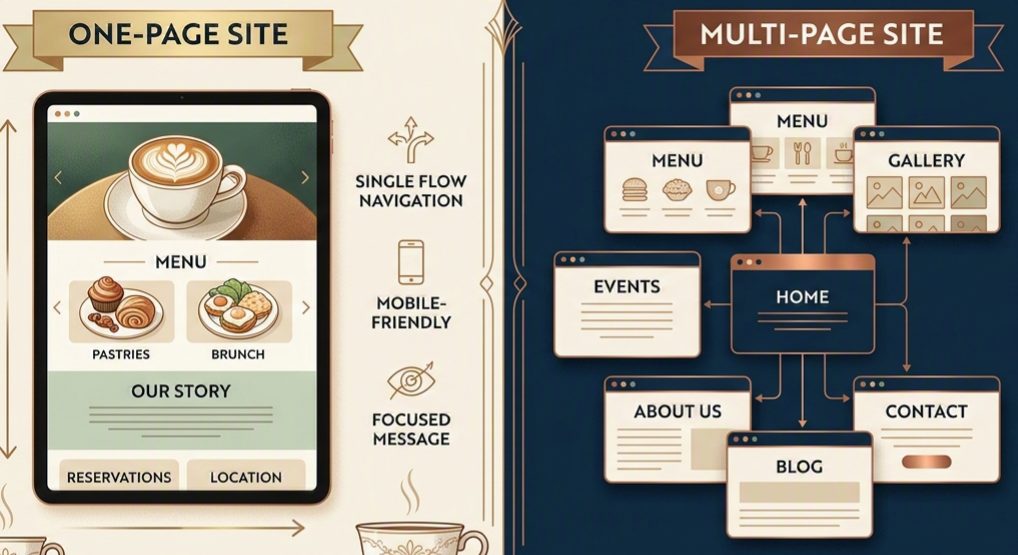
Every website project eventually runs into the same fork in the road: should this live on a single scrolling page, or should it be spread across a proper set of pages with its own navigation? It sounds like a small technical detail, but it shapes your budget, your SEO ceiling, how visitors experience your brand, and how easily the site grows with your business.
There's no universal right answer here — a wedding photographer and a growing SaaS company have very different needs. This guide breaks down one page vs multi page website structures in plain terms, so you can match the format to your goals instead of picking whichever one looked nicest in a template gallery.
What Is a One-Page Website?
A one-page website puts all of your content on a single URL, organized into scrollable sections — hero, about, services, testimonials, contact — usually stitched together with a sticky navigation bar that jumps to each section as visitors scroll. There's no clicking through to separate pages; the entire story unfolds in one continuous scroll.
This format has become the default for landing pages, portfolios, event pages, and early-stage product launches, largely because it forces a tight, focused narrative and feels effortless to browse on a phone.
What Is a Multi-Page Website?
A multi-page website is what most people picture when they think "company website": a homepage plus a set of dedicated pages — About, Services, Pricing, Case Studies, Blog, Contact — each with its own URL and its own job to do. Visitors navigate between pages using a menu rather than scrolling through everything at once.
This is the standard structure for established businesses, e-commerce stores, service providers with multiple offerings, and any organization that publishes ongoing content like articles, resources, or documentation.
One Page vs Multi Page Website: Side-by-Side Comparison
When a One-Page Website Makes Sense
- You're promoting a single offer, event, or product launch
- You're a freelancer, consultant, or personal brand with a simple story to tell
- You need something live fast, like a pre-launch or campaign page
- Your primary goal is one clear action: book a call, join a waitlist, buy one product
- Most of your traffic will come from a single paid campaign or social link, not organic search
The tradeoff is that one-page sites compress everything into a single URL, which caps how many different search terms the page can realistically compete for. If ranking on Google for several distinct topics matters to you, that's a real constraint to weigh early.
When a Multi-Page Website Makes Sense
- You offer multiple services or product lines that each deserve their own explanation
- You plan to publish blog content, case studies, or resources regularly
- SEO and organic traffic are core parts of your growth strategy
- You need dedicated space for trust-building content: team, credentials, detailed FAQs
- You're running an online store where each product or category needs its own page
Multi-page sites take longer to plan and build well, mainly because navigation and information architecture need real thought — a confusing menu can undo the benefit of having more pages in the first place.
A Quick Note on SEO
The most common misconception is that one-page sites are automatically bad for SEO. That's not quite true — a well-optimized one-pager can rank perfectly well for a single, focused keyword. What one-page sites can't do is compete for multiple distinct search intents, since Google generally needs a dedicated page to rank strongly for a dedicated topic.
If your growth plan leans on organic search across several topics — different services, different customer questions, ongoing blog content — a multi-page structure gives each of those topics room to rank on its own.
Is There a Middle Ground?
Often, yes. Many businesses start with a one-page site to launch quickly, then expand into a multi-page structure as their offerings and content needs grow. Others run a lean one-page marketing site alongside a small set of essential pages, like Pricing or a Blog, giving them focus without fully closing the door on SEO.
The key is designing the initial build so it can expand later without a full rebuild — clean sections, a scalable navigation pattern, and a CMS or codebase that isn't locked into a single-page-only structure.
Making the Right Call
If you're still weighing one page vs multi page website for your own project, work backward from two questions: how many distinct things do you need to explain, and how much of your traffic will come from organic search versus a direct link? A single, focused offer with mostly direct traffic usually points to one page. Multiple services, ongoing content, or an SEO-driven growth plan usually point to multi-page.
Either way, the format is just the container — what actually converts visitors is clear messaging, fast load times, and a design that gets out of the way of your offer.