Hidden Costs of Traditional Restaurant POS Systems Nobody Warns You About
That RM 5,000 POS quote looks reasonable — until you read the fine print. Here's a full breakdown of the hidden costs Malaysian restaurant owners consistently discover only after signing the contract.
When a POS salesperson sits across from you in your restaurant, the pitch is always the same: a tidy hardware bundle, a one-time setup fee, and a promise that your operations will run smoother than ever. What they rarely walk you through is the total cost of ownership over three to five years — and in Malaysia's competitive F&B landscape, that gap between the sticker price and the real price can quietly drain thousands of ringgit from your margin every single year.
This article exists because too many restaurant owners have told us the same story: "I thought I was getting a deal." We've mapped out every hidden cost category that traditional restaurant POS systems in Malaysia typically carry, so you can make a fully informed decision before signing anything.
Malaysia-specific note: Many POS vendors here structure contracts with a low upfront cost but high recurring charges — a model that is particularly punishing for independent F&B operators running on thin net margins of 5–15%.
The "Affordable" Upfront Price Is Just the Beginning
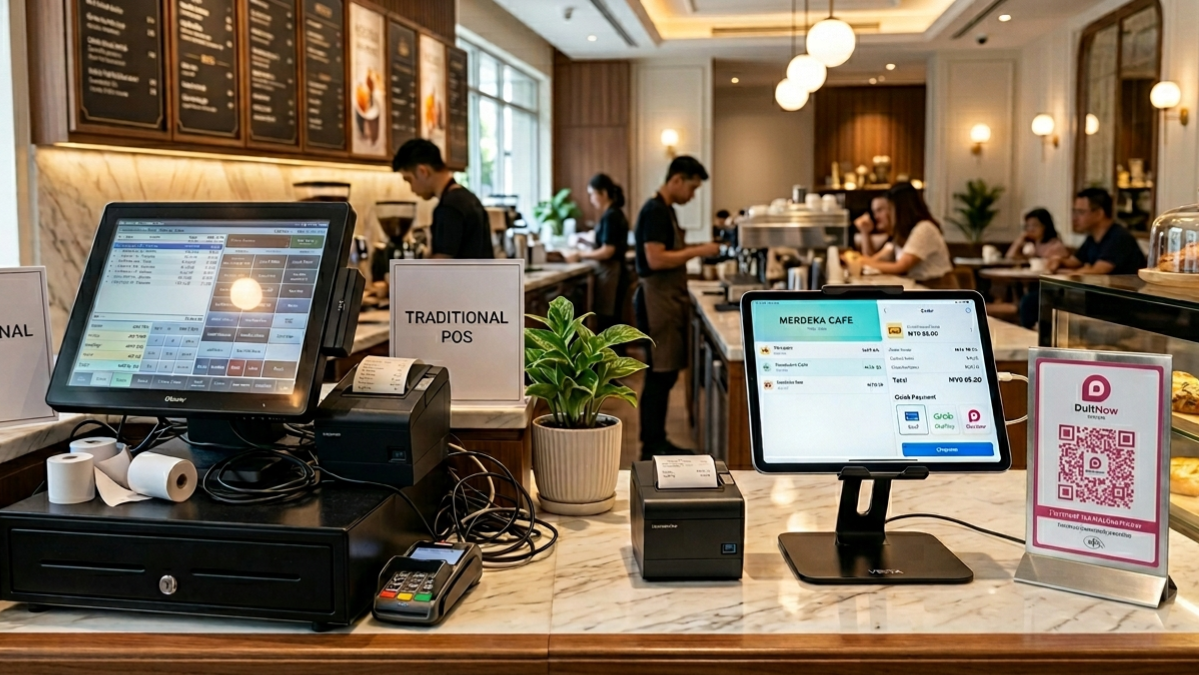
Traditional POS vendors in Malaysia typically advertise packages between RM 3,000 and RM 8,000 for a single terminal. That figure usually covers the hardware — a touchscreen terminal, receipt printer, cash drawer, and maybe a kitchen display unit. It sounds complete. It rarely is.
What that quote almost never includes:
- Software licensing activation fees (often RM 500–RM 1,500 billed separately)
- On-site installation and configuration charges
- Staff training sessions — some vendors charge per session
- Menu programming fees if you have more than a basic item count
- Network setup and cabling if your outlet requires it
By the time your system is actually live and staff-trained, you may have spent 30–50% more than the quoted package price. This isn't accidental — it's a deliberate sales structure designed to get you past the decision point before the full picture emerges.
Annual Software Licensing: The Silent Subscription
Most traditional POS systems in Malaysia use a perpetual software licence model — meaning you "own" the version you bought. This sounds appealing until you realise what it actually means in practice: every major update, every new feature, and sometimes even bug fixes come with a price tag.
Annual software maintenance or "support licence" fees are standard across legacy POS providers. These typically run between RM 800 and RM 2,400 per year per terminal. Skip the renewal and you lose access to updates, which means your system gradually falls behind on security patches, tax regulation compliance (especially relevant with Malaysia's evolving e-invoicing requirements under LHDN), and new payment integrations.
Insight: With Malaysia's mandatory e-invoicing rollout under Peppol standards, restaurants using outdated POS software that hasn't been updated may face compliance gaps — and paying for updates to fix this is a cost that was never in the original sales pitch.
Over a five-year ownership period, licensing fees alone can add RM 4,000 to RM 12,000 per terminal to your total spend — costs that are entirely invisible in the original proposal.
Technical Support: When You're Billed for Every Problem
This is one of the most painful hidden costs Malaysian restaurant owners encounter. Most traditional POS contracts include a warranty period of 12 months — after which technical support becomes a paid service.
Common support billing structures in Malaysia:
On-site callout fees
RM 150–RM 400 per visit, typically with a 4–24 hour response window. A printer jam on a Saturday night could cost you RM 300 and several hours of revenue.
Hourly labour charges
Some vendors bill RM 80–RM 150 per hour on top of the callout fee for complex issues. A half-day fix can cost RM 500+ in labour alone.
Remote support tiers
Basic phone support is free, but screen-share or remote access support is often gated behind a premium support plan costing RM 200–RM 600 per month.
After-hours surcharges
Restaurants operate evenings and weekends. Many vendors charge 1.5–2× rates for support outside standard Monday–Friday business hours.
A restaurant with even 3–4 support incidents per year — extremely common during peak seasons like Ramadan, Chinese New Year, or school holidays when transaction volumes spike — can easily accumulate RM 2,000–RM 5,000 in annual support costs alone.
Proprietary Hardware Lock-In: Paying Forever for the Same Box
Traditional POS vendors often sell proprietary or semi-proprietary hardware — terminals, printers, and peripherals that only work reliably with their software stack. This creates a captive upgrade cycle that benefits the vendor, not you.
When your hardware fails (and it will — most POS terminals have a realistic useful life of 3–5 years under daily restaurant conditions), you typically can't just buy a replacement from the open market. You must purchase the vendor's approved replacement, often at a premium of 20–40% above comparable open-market hardware prices.
The hidden cost here compounds further: if the vendor discontinues a hardware model, you may be forced into a full system upgrade — new terminals, new software version, new training — just to maintain functionality.
Red flag to watch for: If a POS vendor cannot clearly answer "Can I use a standard Android tablet or Windows PC as a terminal?", assume you are locked into their proprietary hardware ecosystem.
Per-Transaction and Payment Integration Fees
Cashless payment adoption in Malaysia has accelerated dramatically — DuitNow QR, Touch 'n Go eWallet, GrabPay, and card terminals are now expected at virtually every dining outlet. What many restaurant owners don't realise is that integrating these payment methods with a traditional POS system often carries its own set of charges.
| Payment Integration | Typical Setup Fee | Ongoing Charges |
|---|---|---|
| Credit / Debit Card (PDQ) | RM 0–RM 500 | MDR: 0.5–1.5% per transaction |
| DuitNow QR Integration | RM 200–RM 800 | Monthly gateway fee + MDR |
| eWallet (TNG, GrabPay) | RM 300–RM 1,000 | Per-transaction MDR varies |
| Middleware / API connector | RM 500–RM 2,000 | Annual licence renewal |
Beyond the integration fees, some legacy POS systems charge a "middleware" or "connector" fee every time you want to link a new payment provider — meaning each new eWallet that gains popularity in Malaysia becomes another line item on your invoice.
The Cost Nobody Calculates: Downtime Revenue Loss
This may be the single most underestimated hidden cost of a traditional restaurant POS system in Malaysia. When your system goes down during a dinner rush, you're not just paying for a repair — you're losing revenue in real time.
Consider a mid-range restaurant in Kuala Lumpur averaging RM 800–RM 1,500 in revenue per hour during peak periods. A 2-hour system outage on a Friday evening could represent RM 1,600–RM 3,000 in lost sales — in a single incident. Add staff overtime trying to manage manual processes, reduced table turns, and the reputational impact of a frustrating customer experience, and the true cost is even higher.
Traditional on-premise POS systems are especially vulnerable to:
- Local server failures (no redundancy)
- Windows OS crashes or security update interruptions
- Database corruption from improper shutdowns (power cuts are common in Malaysia)
- Network switch failures taking down the entire ordering ecosystem
Real-world scenario: A popular mamak in Petaling Jaya experienced a local server crash during the 2025 Chinese New Year period. With no cloud backup, the outlet lost 6 hours of transaction data and had to revert to manual orders for the remainder of the public holiday weekend — estimated revenue impact: RM 12,000.
Third-Party Integration Costs: Delivery Platforms, Accounting & More
Running a modern restaurant in Malaysia means dealing with GrabFood, Foodpanda, ShopeeFood, and your own online ordering — alongside accounting software like SQL Accounting or Xero, and loyalty programmes. Getting a traditional POS to talk to all of these is rarely plug-and-play.
Integration costs you should budget for:
- Delivery aggregator integration: Many POS vendors charge RM 500–RM 2,000 per platform, per integration. Connecting three delivery apps costs up to RM 6,000.
- Accounting software sync: Custom data export setups or middleware bridges can cost RM 1,000–RM 3,000 to configure and require ongoing maintenance fees.
- Loyalty / CRM systems: Unless the POS has a native loyalty module (which often costs extra), third-party CRM integration is typically a custom development project.
- Menu management across channels: Updating your menu across POS, delivery apps, and your own website manually wastes 1–3 hours of staff time per update — a recurring hidden labour cost.
Staff Turnover × Retraining: A Recurring Hidden Tax
Malaysia's F&B industry has one of the highest staff turnover rates of any sector — industry estimates range from 30–70% annually for front-of-house roles. Every time a trained staff member leaves, someone new has to learn your POS system.
With traditional POS systems — which often have complex menu hierarchies, non-intuitive interfaces, and vendor-specific workflows — retraining is slow and error-prone. Vendors sometimes charge for additional training sessions at RM 200–RM 500 per session. Even when internal training is done by a senior staff member, consider the labour hours diverted from actual service.
A restaurant with 40% annual staff turnover, a team of 8 front-of-house staff, and a 4-hour training requirement per new hire is spending approximately 13 training days per year on POS onboarding alone. At RM 50/hour average loaded cost, that's over RM 2,000 in hidden labour expenditure annually — before any vendor training fees.
The True 3-Year Cost: Traditional vs Modern POS
Let's put the numbers together for a single-outlet restaurant in Malaysia to illustrate the real cost difference between a traditional POS and a modern cloud-based alternative:
| Cost Category | Traditional POS (3 yrs) | Cloud POS (3 yrs) |
|---|---|---|
| Hardware & Setup | RM 6,000–RM 10,000 | RM 1,500–RM 3,000 |
| Software Licensing | RM 3,600–RM 7,200 | Included in subscription |
| Technical Support | RM 4,000–RM 8,000 | RM 0–RM 1,200 |
| Integrations | RM 3,000–RM 8,000 | RM 0–RM 2,000 |
| Downtime Revenue Loss | RM 5,000–RM 15,000 | Minimal (cloud redundancy) |
| Retraining & Labour | RM 2,000–RM 5,000 | RM 500–RM 1,500 |
| Total 3-Year TCO | RM 23,600–RM 53,200 | RM 5,000–RM 15,000 |
The comparison isn't just about saving money — it's about redirecting tens of thousands of ringgit that would otherwise disappear into vendor pockets back into your restaurant: better ingredients, a stronger team, or marketing that actually brings customers through the door.
What to Ask Before Signing Any POS Contract in Malaysia
Armed with the above, here are the exact questions every Malaysian restaurant owner should ask any POS vendor before signing:
"What is your annual software maintenance or licensing fee after Year 1?"
Get this in writing. If they can't answer clearly, treat it as a red flag.
"What does technical support cost after warranty expiry?"
Ask for callout fees, hourly rates, remote support tiers, and after-hours pricing separately.
"Can I use standard off-the-shelf hardware, or am I locked into yours?"
Open hardware compatibility protects you from forced upgrade cycles.
"How does the system handle internet downtime or local server failure?"
If the answer is "it stops working", that's a critical operational risk to price into your decision.
"What is the cost of integrating with GrabFood, Foodpanda, and my accounting software?"
Ask for an all-in integration quote, not a per-platform estimate.
"Can I export all my data if I decide to switch providers?"
Data portability is a fundamental right. Any hesitation here signals a deliberate lock-in strategy.
Frequently Asked Questions
Beyond the upfront hardware price, hidden costs include annual software licensing fees, per-transaction charges, paid technical support callouts, mandatory hardware upgrades, staff retraining fees, integration costs for third-party apps, and revenue lost during system downtime.
While vendors advertise packages from RM 3,000–RM 8,000 upfront, the true 3-year total cost of ownership — including licensing, support, hardware replacement, and downtime losses — can easily exceed RM 20,000 for a single outlet in Malaysia.
Yes. Cloud-based and SaaS POS platforms offer transparent monthly pricing, free software updates, remote support, and no proprietary hardware lock-in — significantly reducing the hidden cost burden for F&B operators in Malaysia. ROVA's solutions are built specifically for the Malaysian market with this in mind.
Most legacy POS vendors in Malaysia structure their contracts so that only a limited number of on-site support visits are included. Additional callouts are billed at an hourly or per-visit rate, which can accumulate to thousands of ringgit annually.
It depends on the vendor. Many traditional POS providers store data in proprietary formats, making migration difficult or costly. Cloud-based alternatives typically offer data export tools that make switching more straightforward. Always confirm data portability before signing any contract.
Stop Paying Hidden POS Fees
ROVA offers transparent, all-in pricing built for Malaysian restaurants — no surprise callout bills, no annual licensing traps, no hardware lock-in. Get a clear cost comparison for your outlet today.
Get a Free Cost Analysis