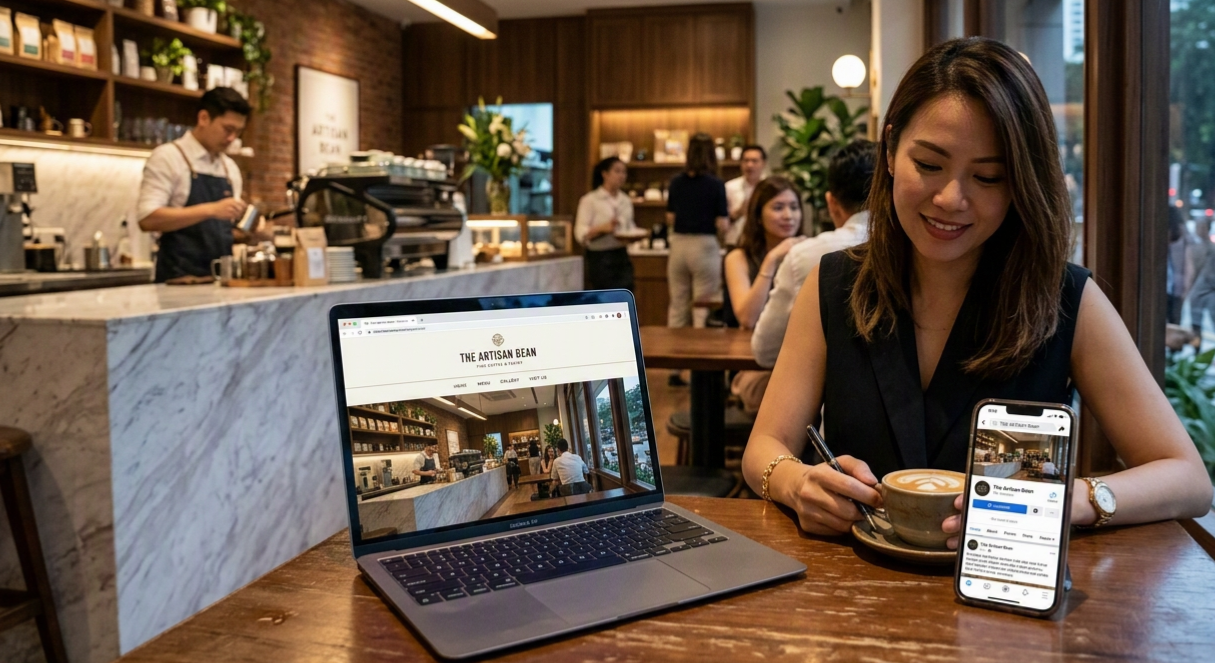
Walk through any pasar malam, mall, or industrial park in Malaysia and you'll see the same thing on almost every signboard: a Facebook logo and a page name, with no website in sight. For a huge number of local businesses, the Facebook Page has quietly become the entire online presence — the "shop," the catalogue, the customer service line, all in one.
It's an understandable habit. Facebook is free to set up, everyone in Malaysia is already on it, and posting a promotion takes two minutes. But business website vs Facebook page isn't really an either-or decision — it's a question of what each one is actually built to do. And for anything beyond a hobby stall, relying on Facebook alone starts to cost you more than it saves.
What a Facebook Page Actually Does Well
To be fair, Facebook earns its popularity. It's genuinely useful for:
- Reaching people who are already scrolling, especially through ads and shares
- Quick, informal updates — a new stock arrival, a temporary closure, a flash promo
- Direct messaging with customers who already know your brand
- Building a community around reviews, comments, and repeat engagement
None of that is in dispute. The problem isn't that Facebook is bad — it's that it was built to keep people inside Facebook, not to represent your business independently.
You Don't Own It
This is the single biggest risk, and it's not hypothetical. Malaysian business owners report Pages getting restricted, unpublished, or permanently disabled — sometimes over a false copyright claim, a mass reporting attack from a competitor, or an algorithm mistake — with little recourse and no phone number to call for help.
When that happens, everything disappears at once: your reviews, your post history, your follower count, your only way of reaching existing customers. A website lives on your own domain and hosting. You control it, and no platform policy change can switch it off overnight.
Facebook Doesn't Help People Find You on Google
Most Malaysian consumers still start a purchase decision with a Google search — "kedai kek near me," "renovation contractor Klang Valley," "affordable braces Penang." Facebook Pages rank poorly for these searches compared to dedicated business websites, because Google can't index the depth of content, structure, and keywords that a proper site provides.
A website with clear service pages, location information, and content built around what customers actually search for gives you a real shot at organic Google traffic — visitors actively looking for what you sell, arriving without you paying for a single ad.
Credibility Still Matters
Rightly or wrongly, a business with only a Facebook Page still reads as smaller or less established to many customers — particularly for higher-ticket purchases like renovation, education, healthcare, or B2B services. A proper website signals permanence: a real domain, a professional layout, and a place where a customer can quietly verify who you are before they commit to spending money with you.
This matters even more once you're dealing with corporate clients, government tenders, or partnerships — many of these simply expect a company website to exist as a baseline, regardless of how active your Facebook Page is.
What a Website Can Do That Facebook Can't
- Custom booking, ordering, or quotation forms built around your exact process
- Integrated payment gateways, delivery tracking, or e-invoicing as your business grows
- A structured product or service catalogue that's easy to browse, not buried in old posts
- Full control over design, branding, and how information is organized
- Analytics you own — real data on who visits, what they view, and where they drop off
As Malaysia moves further into e-invoicing requirements and digital-first customer expectations, these are increasingly not "nice to haves" but basic infrastructure for running a business smoothly.
The Right Answer Is Usually Both
None of this means dropping Facebook — for many Malaysian businesses, it's still where a lot of real engagement happens. The smarter setup is a website as your permanent home base, with Facebook (and Instagram, WhatsApp, or TikTok) as the channels that drive traffic to it. Your website becomes the place every ad, post, and bio link eventually points back to — the one asset that's still standing no matter what happens to any single platform.
Bottom Line
A Facebook Page is a channel. A website is a foundation. For a Malaysian business serious about growing past word-of-mouth and platform algorithms, the two aren't competing for the same job — you need both, but only one of them is actually yours.