Short answer: neither option is fee-free, but which one costs your restaurant more depends on your average ticket size. Pay-at-counter cash has no payment gateway fees at all, but card and QR payments taken at the counter carry the exact same fees as online orders. For most Malaysian restaurants, the real way to avoid payment gateway fees isn't choosing counter vs. online — it's routing each order to the cheapest rail for its size, which usually means DuitNow QR or e-wallets for small tickets and FPX for larger ones. Below is the real math, plus five changes you can make this month.
Pay at Counter vs Online Payment: Which Saves Your Restaurant More?
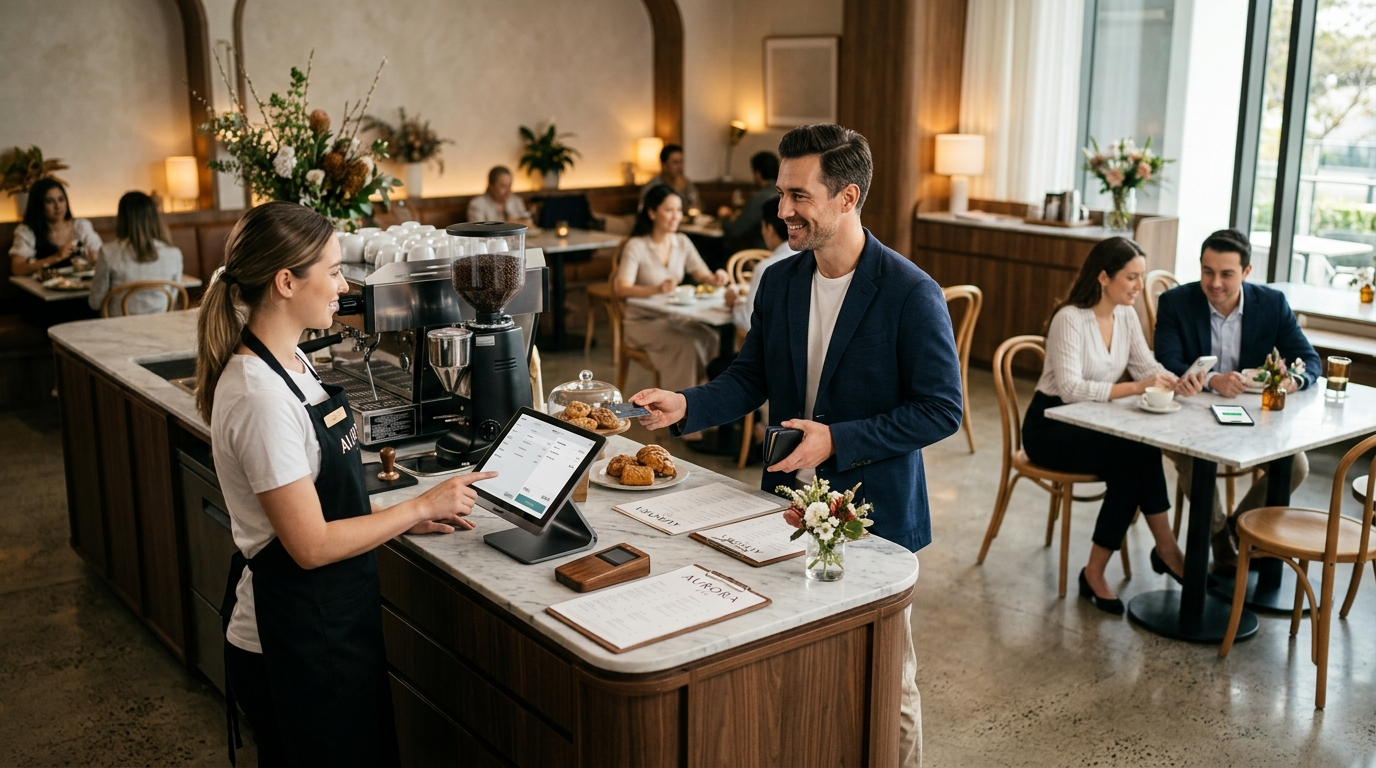
What "payment gateway fees" actually cost a Malaysian restaurant
Before comparing counter vs. online, it helps to know what's actually inside a "payment gateway fee" line item. It's rarely one number — it's usually three or four stacked together:
| Payment method | Typical fee in Malaysia | Fee type |
|---|---|---|
| Credit / debit card (MDR) | ~1.5% – 3.0% | Percentage of order value |
| DuitNow QR / e-wallets | ~1.0% – 1.7% | Percentage of order value |
| FPX online banking | ~RM0.50 – RM2.00 | Flat fee per transaction |
| Cash at counter | RM0 | No gateway fee (but see below) |
Ranges are indicative market rates as of mid-2026 and vary by provider, volume, and negotiated terms — always confirm current pricing with your gateway.
On top of whichever rate applies, Malaysia's 8% Sales and Service Tax (SST) is charged on the gateway's service fee, not on the value of the customer's order. That's a detail worth checking on your monthly statement — some gateways show it as a separate line, others bundle it into the total, which makes two "similar" quotes harder to compare than they look.
Pay at counter: what it really costs
"Pay at counter" only avoids gateway fees if the customer hands over physical cash. The moment they tap a card or scan a QR code at your till, the same MDR, e-wallet rate, and SST apply as they would online — the fee is charged by the payment method, not by where the customer was standing when they paid.
What pay-at-counter does change is a different set of costs that don't show up on a gateway invoice:
- Staff time — someone has to take the order, walk it to the till, and process payment, which is labour cost per transaction that online ordering removes.
- Cash handling — float management, end-of-day reconciliation, and till shortages are a real, recurring cost even though they never appear as a "fee."
- Order errors — orders taken verbally or scribbled by hand have a higher correction/refund rate than orders a customer typed themselves.
- Slower table turnover — customers queue to pay rather than paying the moment they're ready, which caps how many covers you can seat per hour at peak times.
Online / QR ordering: what it really costs
Online and at-table QR ordering route every order through a payment gateway, so gateway fees are unavoidable here — but the total cost per order is often lower once you account for what it replaces. A customer places and pays for their own order, which cuts the staff time per transaction, reduces mis-orders, and lets you seat the next table without waiting on the till queue. The trade-off is that every single order now carries an MDR, e-wallet rate, or FPX fee, whereas some counter cash transactions carried none.
The math: a RM40,000/month restaurant, three ways
Here's a worked example for a casual restaurant doing roughly RM40,000 in monthly revenue at an average ticket of RM28 — about 1,430 orders a month. These are illustrative estimates to show the shape of the trade-off, not a quote for your specific mix.
| Scenario | Est. monthly fee | What drives it |
|---|---|---|
| All cash at counter | RM0 gateway fees | Staff time + till reconciliation cost sits elsewhere, off this line |
| All card (counter or online), ~1.8% MDR | ~RM720 + SST | 1,430 orders × RM28 × 1.8% |
| All FPX, flat ~RM1.00/txn | ~RM1,430 + SST | Flat fee is expensive at a small RM28 ticket |
| All DuitNow QR / e-wallet, ~1.3% | ~RM520 + SST | 1,430 orders × RM28 × 1.3% — the cheapest digital rail here |
The counter-intuitive result: at a small average ticket, FPX — often assumed to be the "cheap" option — is actually the most expensive digital method, because its flat per-transaction fee doesn't scale down with order size. A flat RM1.00 fee is 2% of a RM50 order but over 6% of a RM15 order. FPX only becomes competitive once your average ticket climbs past roughly RM55–80, depending on the exact rates you're quoted. Below that, DuitNow QR and e-wallets typically win.
5 ways to avoid unnecessary payment gateway fees
- Route small tickets to DuitNow QR or e-wallets, not FPX. If your average order is under ~RM50, a flat-fee rail like FPX usually costs more, proportionally, than a percentage-based one. Save FPX for catering orders, deposits, or larger group bills.
- Negotiate your MDR once you have volume data. Setup fees, MDR, and payout terms are often negotiable once you can show a few months of consistent transaction volume — most restaurants never ask.
- Check whether SST is a separate line or buried in the rate. Two quotes that look identical on MDR can differ once you see whether the 8% SST on the service fee is itemised or already folded in.
- Reduce transaction count, not just the rate. Encouraging one combined checkout per table instead of several small split payments cuts the number of transactions the fee applies to.
- Weigh the fee against what it replaces. A QR ordering system that removes a staff member's worth of order-taking time can be cheaper overall than "fee-free" cash, even after the gateway's cut — the fee is one line item, not the whole picture. This is the logic behind ROVA's QR ordering, which lets customers order and pay at the table while routing payments through low-cost local rails.
So which actually saves more?
| Factor | Pay at counter | Online / QR payment |
|---|---|---|
| Gateway fee exposure | Only on card/QR taps — cash is free | Every order, but rate is controllable |
| Staff time per order | Higher — order + payment both need a staff member | Lower — customer self-serves |
| Table turnover | Slower at peak, queue at the till | Faster — pay the moment they're ready |
| Order accuracy | More prone to human mis-entry | Customer types their own order |
| Best for | Small stalls, mostly-cash local crowds | Sit-down restaurants, higher covers/hour |
There's no universal winner — it comes down to your average ticket size, your labour cost per order, and how much of your volume is genuinely cash. A hawker stall with a RM8 average ticket and loyal cash customers may do fine staying counter-first. A sit-down restaurant processing 1,000+ orders a month is usually better off routing digital payments to the cheapest rail per order size and using that saved staff time to turn more tables — see how ROVA's food ordering pricing breaks down for restaurants your size.
See your actual blended fee rate
ROVA routes each order to the lowest-cost payment rail automatically, so you're not guessing between MDR, FPX, and e-wallet rates order by order.
Frequently asked questions
What is the cheapest way for a restaurant to accept payment in Malaysia?
For most restaurants, DuitNow QR or e-wallets are the cheapest digital option because they charge a small percentage (roughly 1%–1.7%) instead of a flat fee, which keeps costs low even on a small average ticket. Cash at the counter has no gateway fee at all, but it carries hidden costs of its own — staff time, float management, and reconciliation errors.
Does pay-at-counter avoid payment gateway fees completely?
Only if the customer pays in physical cash. A card tap or QR scan at the counter carries the same MDR and SST as an online payment — the fee follows the payment method, not the location of the order.
Is DuitNow QR cheaper than card payment for restaurants?
Usually, yes. Card payments typically run around 1.5%–3% MDR in Malaysia, while DuitNow QR and major e-wallets are typically closer to 1%–1.7%. On a small restaurant ticket, that gap adds up fast across hundreds of monthly orders.
Should a small restaurant skip online payment entirely to save on fees?
Rarely a good trade. Skipping digital payment removes gateway fees but usually costs more in lost table turnover, order errors, and staff hours. Most restaurants save more overall by routing orders to the cheapest suitable rail than by avoiding digital payment altogether.
How much SST do Malaysian restaurants pay on payment gateway fees?
An 8% Sales and Service Tax applies to the gateway's service fee itself, not to the value of the customer's order — worth confirming whether your gateway itemises it separately on your monthly statement.
Related reading
Note for publisher: swap the second link for 2–3 specific same-cluster posts (e.g. a "ROVA vs [competitor] POS fees" or a DuitNow QR explainer) once their slugs exist, per the internal-linking checklist.